Introduction
For many people, Roblox still brings to mind colorful blocks, simple obstacle courses, and games created by hobbyists. That perception is understandable—it reflects Roblox's early years. However, today's Roblox is something entirely different.
Over the past two decades, Roblox has evolved into a sophisticated real-time engine capable of supporting complex multiplayer experiences, realistic physics, AI-driven NPCs, cinematic lighting, procedural generation, cross-platform networking, immersive social systems, and a thriving creator economy. What began as a sandbox for imagination has matured into a professional game development ecosystem used by independent developers, established studios, educators, brands, and millions of creators worldwide.
Today, developers build everything from realistic military simulators and racing games to MMORPGs, survival adventures, horror experiences, educational platforms, digital concerts, and virtual fashion marketplaces—all within Roblox.
This article explores the evolution of the Roblox Engine, the technologies behind its growth, and why it has become far more than "just blocks."
The Early Days (2004–2006)
Roblox began as a physics experimentation platform.
Originally developed by David Baszucki and Erik Cassel, the project focused on giving users the ability to experiment with interactive physics rather than simply play games.
The early engine featured:
- Primitive block construction
- Basic rigid-body physics
- Simple joints
- Basic scripting
- Multiplayer functionality
- User-generated worlds
The visual style was intentionally minimal. Performance mattered more than graphics.
Despite its simplicity, one revolutionary concept emerged:
Players could become developers.
Instead of consuming content, users could build experiences themselves.
This philosophy became Roblox's greatest strength.
The Era of Creativity
Unlike traditional games that shipped with fixed content, Roblox continuously expanded because every player could become a creator.
Developers built:
- Obstacle courses
- Tycoon games
- Roleplay cities
- Adventure maps
- Racing games
- Military simulators
- Puzzle games
- Educational projects
Each year, more tools were added to Roblox Studio, making game creation increasingly accessible without requiring expensive software.
The Birth of Roblox Studio
Roblox Studio became the centerpiece of the ecosystem.
Initially, it was a relatively simple level editor.
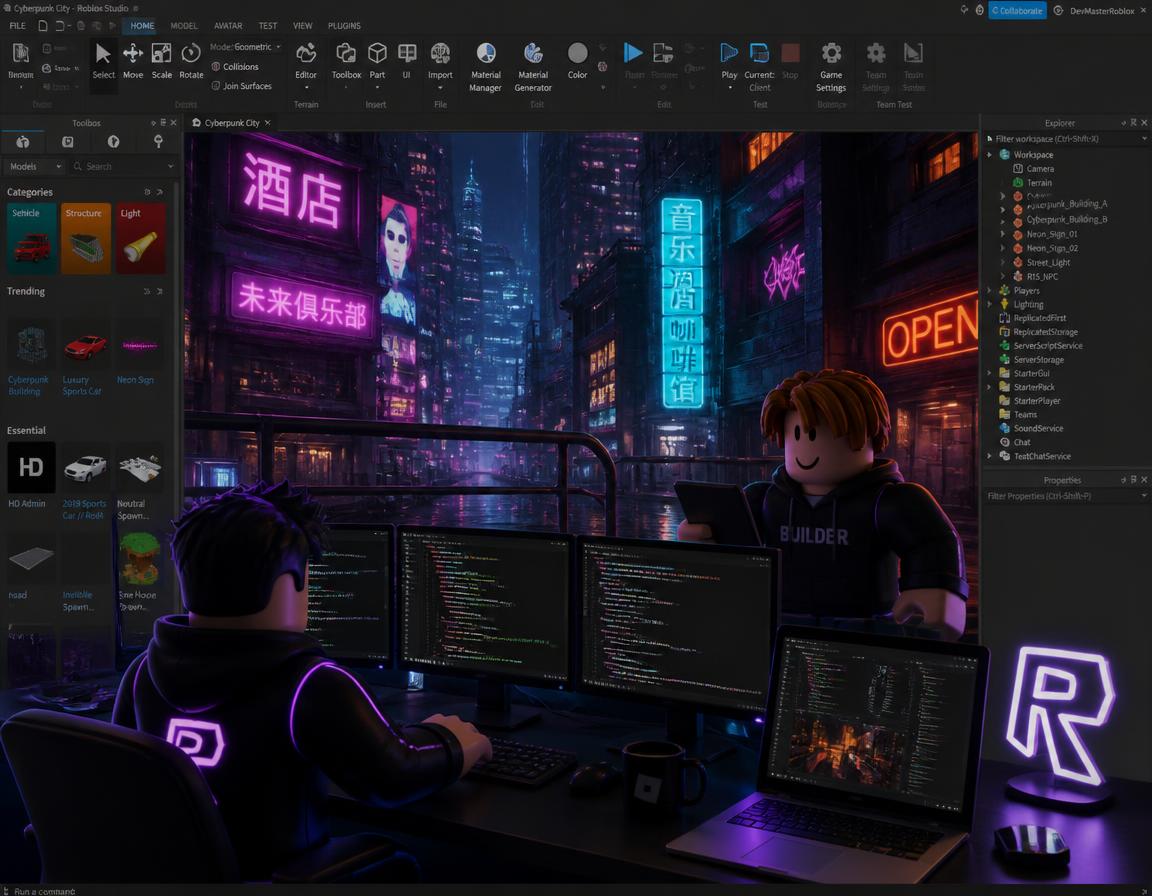
Today it functions as a full-featured game development environment.
Modern Roblox Studio includes:
- Scene editor
- Terrain editor
- Animation editor
- Material editor
- Particle editor
- Pathfinding tools
- Audio editor
- Asset manager
- Team collaboration
- Source control integration
- Plugin architecture
- Debugging tools
- Performance profiler
Many independent developers now spend thousands of hours working inside Roblox Studio much like professionals use Unity or Unreal Engine.
Lua and the Rise of Luau
One of Roblox's smartest decisions was choosing Lua as its scripting language.
Lua was:
- Lightweight
- Easy to learn
- Fast
- Flexible
As projects became increasingly complex, Roblox introduced Luau, an enhanced version of Lua designed specifically for large-scale game development.
Luau added:
- Static type checking
- Better autocomplete
- Faster execution
- Improved memory management
- Enhanced debugging
- Safer coding practices
These improvements enabled teams to build codebases containing hundreds of thousands of lines while maintaining readability and performance.
Rendering Evolution
One of the biggest transformations occurred in graphics rendering.
Early Roblox featured:
- Flat lighting
- Basic materials
- Minimal shadows
- Primitive textures
Modern Roblox supports technologies including:
- Physically Based Rendering (PBR)
- Surface Appearance
- High-resolution textures
- Dynamic shadows
- Future Lighting
- Shadow maps
- Reflection probes
- Volumetric effects
- Atmospheric scattering
- HDR environments
- Post-processing effects
Experiences that once resembled toy worlds can now achieve visuals approaching stylized indie games.
Physics Engine Improvements
Physics has always been central to Roblox.
The engine has continuously evolved with improvements such as:
- Better collision detection
- Improved constraints
- Stable ragdoll systems
- Vehicle suspension
- Rope simulation
- Hinges
- Springs
- Ball sockets
- Motors
- Aerodynamics improvements
- Network ownership optimization
Developers can now create:
- Aircraft simulators
- Construction equipment
- Roller coasters
- Mechanical puzzles
- Destructible systems
- Industrial machinery
Terrain Generation
Terrain once consisted primarily of blocks.
Modern terrain supports voxel-based environments including:
- Mountains
- Rivers
- Oceans
- Caves
- Snow
- Grass
- Sand
- Desert biomes
- Lava
- Marshlands
Terrain tools allow:
- Sculpting
- Painting
- Erosion
- Water editing
- Cave generation
Large open worlds are now practical without requiring millions of individual parts.
Character Evolution
Classic Roblox avatars were intentionally simple.
Over time, the platform introduced:
R6
- Six body parts
- Limited animation
- Iconic appearance
R15
- Fifteen body parts
- Smooth movement
- Better animation blending
- Dynamic scaling
Later developments introduced:
- Facial animation
- Layered clothing
- Dynamic heads
- Emotes
- Bone-based animation
- Accessory attachment systems
These improvements dramatically expanded creative possibilities for character designers.
Animation System
Animation has advanced significantly.
Modern creators use:
- Keyframe animation
- Bone rigs
- IK support
- Animation blending
- State machines
- Facial animation
- Custom emotes
- Motion interpolation
Complex NPCs now exhibit fluid, lifelike movement.
Networking Improvements
Multiplayer synchronization has improved through:
- Replication optimization
- StreamingEnabled
- Client prediction
- Server authority
- Bandwidth optimization
- Network ownership
- Data compression
These systems allow expansive multiplayer experiences while reducing latency and improving scalability.
Streaming Technology
Large worlds previously required loading every asset simultaneously.
Streaming technology changed this by loading nearby content dynamically.
Benefits include:
- Faster loading times
- Reduced memory usage
- Larger maps
- Improved mobile performance
- Better server scalability
This enables developers to create seamless open-world experiences.
Artificial Intelligence
Roblox now supports increasingly sophisticated AI systems.
Developers build NPCs using:
- Pathfinding
- Behavior trees
- State machines
- Vision systems
- Hearing systems
- Patrol routines
- Combat AI
- Dialogue systems
AI can drive everything from friendly shopkeepers to challenging boss encounters.
Audio Revolution
Audio has evolved beyond simple sound effects.
Developers now utilize:
- Spatial audio
- Environmental reverb
- Voice chat integration
- Directional sound
- Dynamic music systems
- Interactive ambience
Immersive audio significantly enhances player engagement.
User Interface Modernization
Roblox UI capabilities have matured with:
- Responsive layouts
- Automatic scaling
- Rich text
- UI gradients
- Tween animations
- Advanced input handling
- Mobile optimization
- Gamepad compatibility
Well-designed interfaces now rival those found in standalone games.
Cross-Platform Ecosystem
One of Roblox's greatest strengths is seamless cross-platform support.
Experiences can run on:
- Windows
- macOS
- iOS
- Android
- Xbox
- PlayStation
- VR-supported devices
Developers write a single experience while reaching millions of users across different hardware.
Marketplace and Asset Ecosystem
Roblox has developed a robust marketplace for digital assets.
Creators can publish:
- Models
- Meshes
- Audio
- Animations
- Plugins
- Clothing
- Accessories
- Materials
This ecosystem accelerates development and enables collaboration among creators.
The Creator Economy
Roblox has built one of the largest creator economies in gaming.
Revenue opportunities include:
- Premium payouts
- Game passes
- Developer products
- UGC item sales
- Sponsored experiences
- Brand collaborations
- Avatar accessories
- Virtual events
Independent developers and studios have built sustainable businesses within the platform.
Team Development
Modern Roblox projects often resemble professional software development.
Teams may include:
- Producers
- Game designers
- Environment artists
- Character artists
- Technical artists
- Programmers
- UI/UX designers
- Animators
- Audio engineers
- QA testers
- Community managers
Collaboration tools within Roblox Studio support efficient workflows across distributed teams.
Performance Optimization
The engine provides extensive tools for optimization, including:
- MicroProfiler
- Script Performance tools
- Memory analysis
- GPU statistics
- Physics visualization
- Network diagnostics
- Streaming analysis
These tools help developers identify bottlenecks and improve player experience.
Cloud Services and Data Management
Modern Roblox experiences rely heavily on cloud-based systems, such as:
- DataStores
- OrderedDataStores
- MemoryStore
- MessagingService
- TeleportService
- BadgeService
- Analytics
These services enable persistent progression, matchmaking, leaderboards, and live events.
Safety and Moderation
As Roblox expanded globally, it invested heavily in trust and safety systems.
Current features include:
- Automated content moderation
- Text filtering
- Voice moderation
- Account protections
- Parental controls
- Privacy settings
- Reporting tools
Maintaining a safe environment remains a core priority for the platform.
Emerging Technologies
The Roblox Engine continues to evolve with investments in:
- Generative AI development tools
- Improved avatar technology
- Procedural content generation
- Enhanced physics simulation
- Better rendering pipelines
- Real-time collaboration
- Immersive communication
- Scalable cloud infrastructure
These innovations are shaping the future of interactive digital experiences.
Why Roblox Matters Beyond Gaming
Roblox is increasingly used outside traditional gaming.
Organizations and creators use it for:
- Virtual classrooms
- Interactive training
- Product showcases
- Fashion exhibitions
- Live concerts
- Brand activations
- Social experiences
- Community events
The platform has become a versatile environment for creativity, education, entertainment, and digital commerce.
Challenges Ahead
Despite its impressive growth, Roblox faces ongoing challenges, including:
- Balancing accessibility with advanced development features.
- Optimizing performance across a wide range of devices.
- Strengthening moderation and online safety.
- Supporting increasingly ambitious creator projects.
- Managing the demands of a rapidly expanding global community.
Addressing these areas will be essential as the platform continues to mature.
Looking to the Future
The next chapter of Roblox is likely to emphasize richer simulations, smarter AI-assisted development, more immersive social experiences, and deeper interoperability between digital assets and experiences. As hardware improves and cloud technologies advance, creators will be able to build even larger, more detailed, and more interactive worlds without sacrificing accessibility.
For developers, artists, and entrepreneurs, Roblox represents more than a game engine—it is a complete ecosystem where creativity, technology, and community intersect.
Conclusion
The story of the Roblox Engine is one of continuous innovation. What began as a simple platform built around blocks and basic physics has evolved into a sophisticated creation ecosystem capable of supporting complex games, immersive simulations, virtual events, educational experiences, and thriving digital businesses.
Its success lies not only in technological progress but also in empowering millions of creators to imagine, build, and share experiences with a global audience. With advancements in rendering, networking, scripting, AI, and creator tools, Roblox has established itself as one of the most accessible yet powerful real-time development platforms available today.
The phrase "Beyond the Blocks" captures this transformation perfectly. Roblox is no longer defined by its iconic cubes—it is defined by the limitless creativity of the people who use it. As the engine continues to evolve, it is poised to remain at the forefront of interactive digital experiences, inspiring the next generation of developers, artists, educators, and entrepreneurs.